
Peter Rabbit: a small book, a wider picture
The Tale of Peter Rabbit, 1902
On Potter’s spare storytelling, her small, softly edged illustrations, and how we extend them to 16:9 with generative AI.
The Tale of Peter Rabbit fits into a child’s hands. Its prose is spare, and many of its pictures are small vignettes whose colour fades into white paper. Both words and pictures leave room for the reader.
Bringing the story to a screen means making decisions about that format. Here we begin with the little book and what it does, before showing how we have worked with its pictures.
The letter that had nothing to say
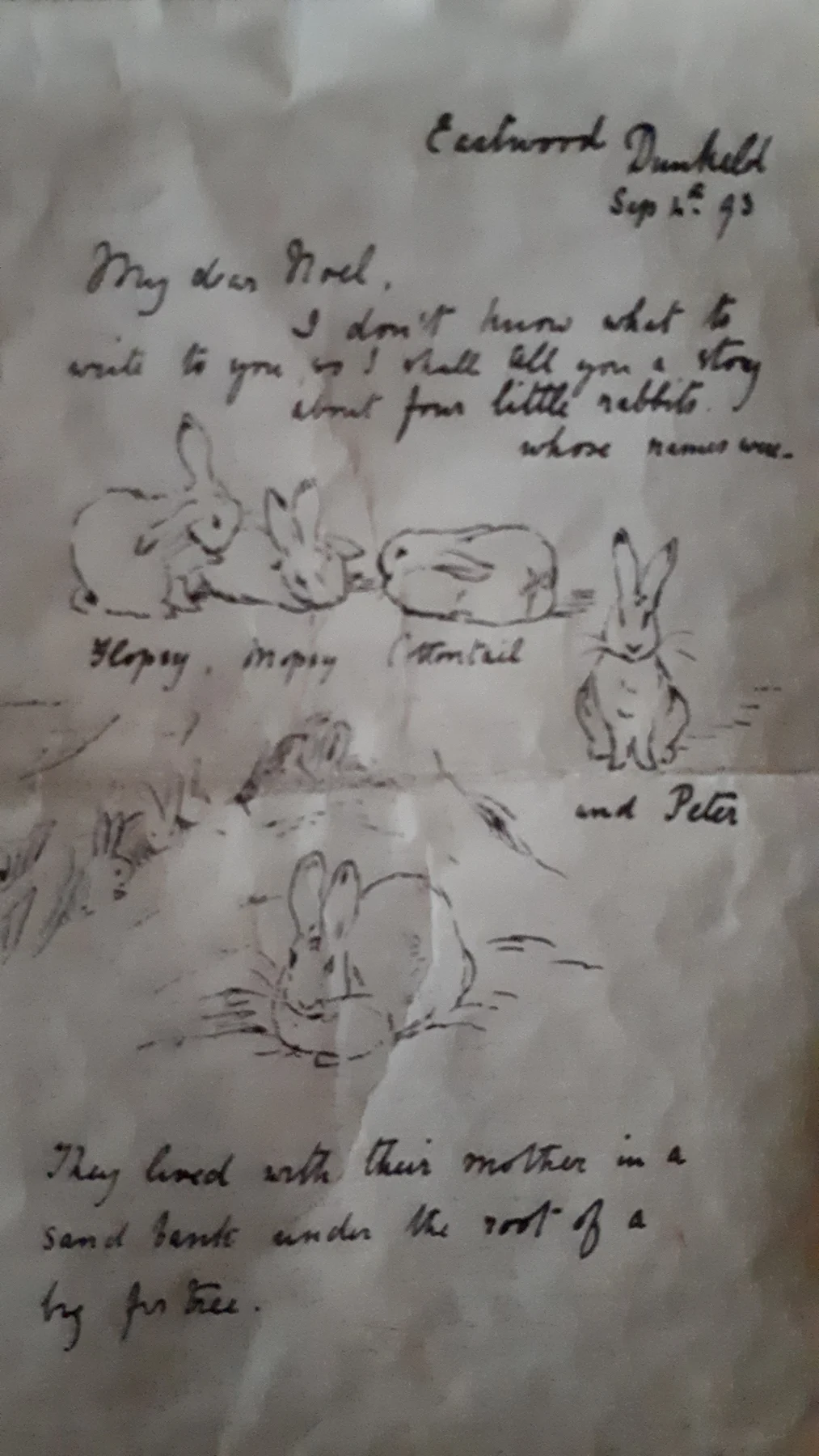
On 4 September 1893, Potter wrote to Noel Moore, a boy of five who was ill in bed.
My dear Noel, I don’t know what to write to you, so I shall tell you a story about four little rabbits, whose names were Flopsy, Mopsy, Cotton-tail and Peter.
She drew the rabbits and wrote their names beneath their ears. Noel kept the letter. Seven years later his mother Annie, Potter’s former governess, suggested that the picture letters might make books.

Six publishers said no
She wrote the story out properly in 1901, and six publishers declined it. So she had it printed herself. On 16 December 1901, Strangeways & Sons ran off 250 copies with black and white illustrations. She gave them to friends and sold the rest, and they went fast enough that she had 200 more printed.
The size of the book was hers, and she was stubborn about it, and her reason was not about design.
little rabbits cannot afford to spend 6 shillings on one book and would never buy it
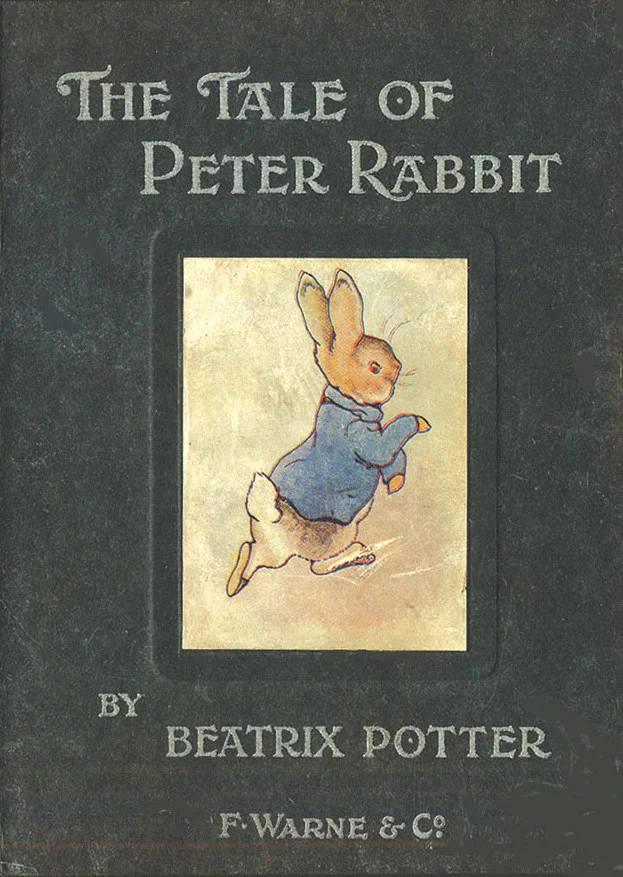

That is the whole argument for the shape of every Potter book: small enough for a child to hold open without help, cheap enough for the child to be the one who owns it. The same day her private edition was printed, Frederick Warne wrote offering terms. They wanted the text cut and the pictures in colour. She did both. The trade edition came out in October 1902 in 8,000 copies, 12,000 more followed in November and another 8,220 in December. By the end of 1903 it had sold 50,000.
What the prose does, and what it will not do
Read Peter Rabbit aloud as an adult and the surprise is how little the narrator wants from you.
The most frightening fact in the book is delivered in passing, by his mother, on her way out of the door.
don’t go into Mr. McGregor’s garden: your Father had an accident there; he was put in a pie by Mrs. McGregor.
No pause is left for it. Nobody is upset. The sentence walks straight on to the basket and the umbrella and the five currant buns.
Notice what is doing the work there. Had an accident is a soft phrase, and Potter follows it immediately with the hard one, in the same breath, at the same volume. She does not lower her voice for either. That is the old technique and the one most often mislaid: hard material is carried by the plainness of the telling, not by the choice of gentler words. It is the adult’s hesitation that frightens a child. The fact, said levelly, does not.
The comedy works the same way, by understatement and by declining to explain the joke.
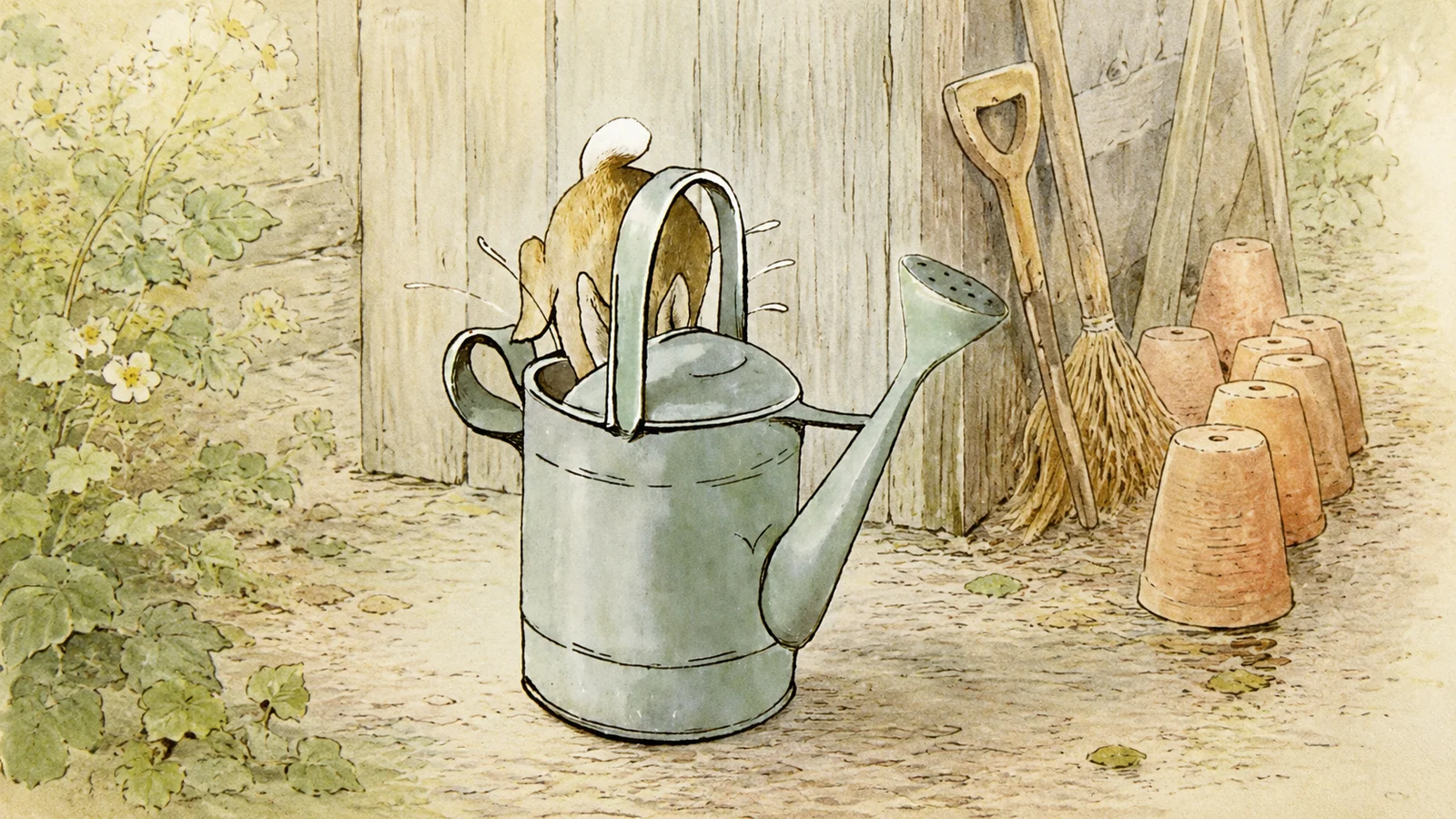
It would have been a beautiful thing to hide in, if it had not had so much water in it.
And when Peter is finally gone, Potter does not follow him. She stays in the garden a moment longer for a detail she cannot resist:
Mr. McGregor hung up the little jacket and the shoes for a scare-crow to frighten the blackbirds.
The blue jacket with the brass buttons, quite new, ends its life on a stick in a vegetable patch. Nothing is said about it.
Then the last line of the book, which is the reason it lasts:
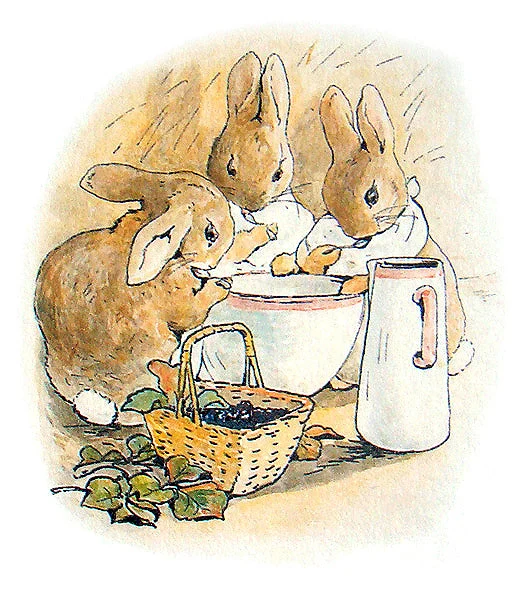
But Flopsy, Mopsy, and Cotton-tail had bread and milk and blackberries for supper.
Peter is upstairs with camomile tea. His sisters, who did as they were told, are having blackberries. That is the entire moral, and it is never stated, and it does not need to be, because a child hearing it knows exactly what he has missed. A modern telling would add a sentence here. Potter puts a full stop and ends the book.
From soft edges to 16:9
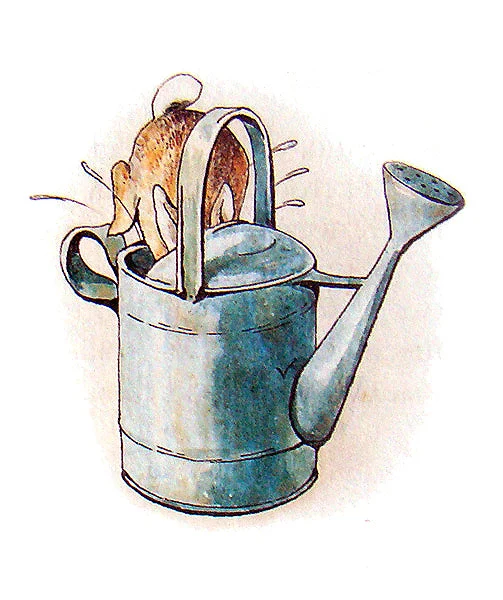
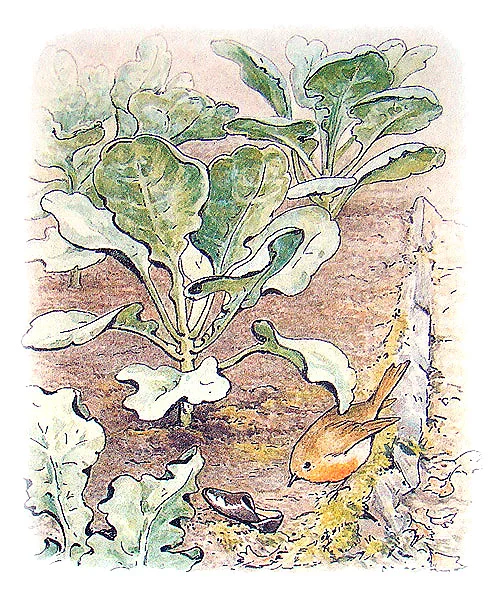
Potter’s original illustrations are often small, rounded or irregular vignettes. A vegetable patch or a rabbit’s fur fades into the white of the paper instead of stopping at a hard rectangular border. The white around the picture is part of the page’s composition.
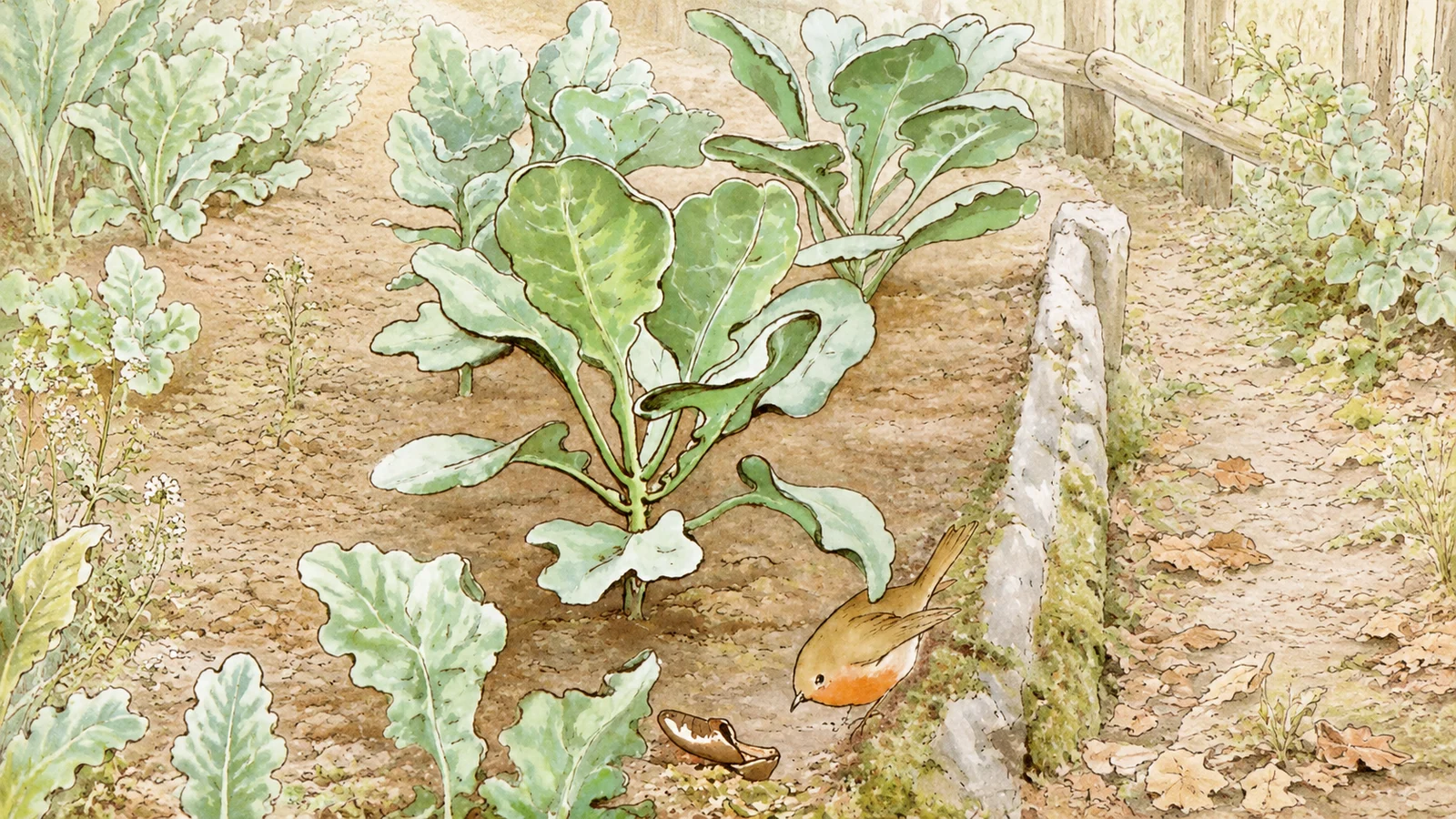
For our version, we have used generative AI to carefully extend the illustrations into full 16:9 panels. We start with Potter’s picture and continue the setting beyond its original edges. The aim is to keep the character of the scene, with colours, lines and new details that sit comfortably alongside what is already there.
Around the watering-can, the extension adds a wall, tools, pots and ground. In the lost-shoe scene, the cabbages, path and fence continue out to the sides. The comparisons below show the originals beside our adaptations.
The added areas are our AI-assisted interpretation. They are not recovered parts of Potter’s drawings. A person reviews each finished image and approves or rejects it, as described in our pledge.
What to listen for
The English strict reading follows Potter’s text word for word. The Swedish reading is a translation.
If you are listening alongside your child, listen for what the narrator leaves unexplained. No aside to the grown-up in the room, no line explaining what Peter should have learned. The blackberries are downstairs and the camomile tea is upstairs. Potter lets the difference speak for itself.
The woman behind the book gave the same attention to fungi and sheep. Read our article about Beatrix Potter’s life.
Sources
- Wikipedia, The Tale of Peter Rabbit. The six publishers’ refusals and 50,000 copies sold by the end of 1903.
- Victoria and Albert Museum, Peter Rabbit: the tale of ‘The Tale’: vam.ac.uk: the 4 September 1893 letter to Noel Moore; Strangeways & Sons printing 250 copies on 16 December 1901; the “little rabbits cannot afford to spend 6 shillings” quotation; Warne’s terms the same day; print runs of 8,000 / 12,000 / 8,220 in October, November and December 1902.
- Text quotations are from the Frederick Warne 1902 edition, Project Gutenberg #14838, and match the English source text used for our strict reading.
Image credits
The original illustrations come from the 1902 edition, via Project Gutenberg #14838. The letter facsimile and cover have source links in their captions. The two wide panels are The Loreling’s AI-assisted adaptations of Potter’s originals.